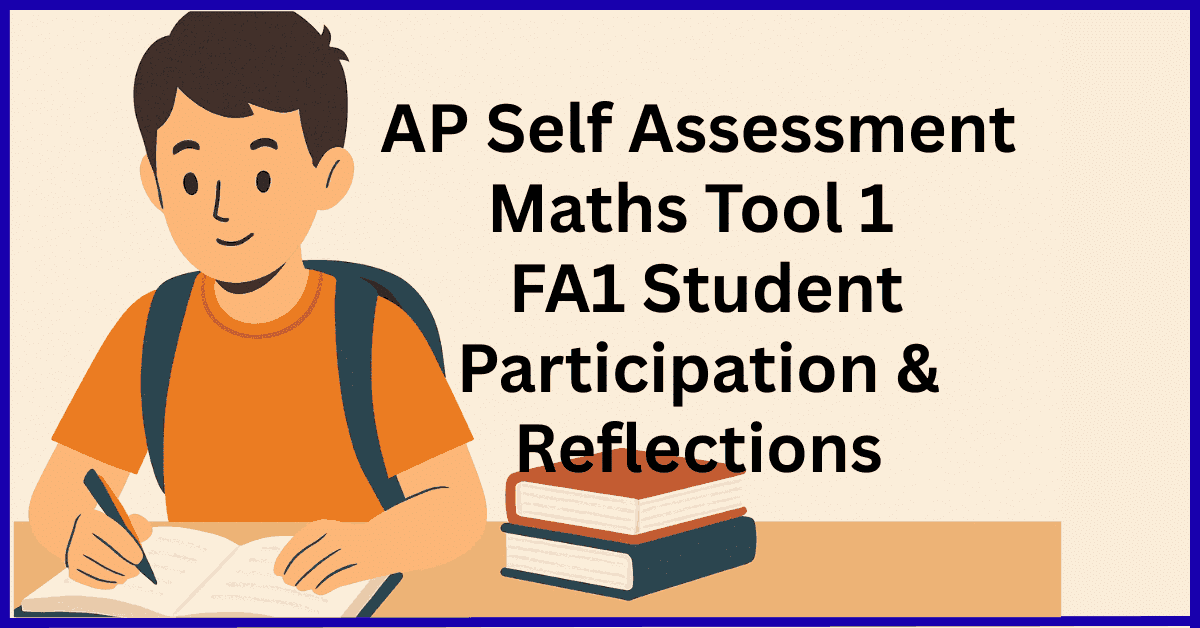
AP Self Assessment Maths Tool 1 plays an important role in evaluating the learning progress of students in FA1 Mathematics. It encourages both student participation and self-reflection, allowing learners to assess their own understanding while teachers gain valuable insights into classroom performance, 2025-2026. By using this tool, students in classes 1 to 5 and 6 to 10 can develop critical thinking, problem-solving skills, and self-confidence in mathematics.
The AP Self Assessment Maths Tool 1 focuses on a structured evaluation process that covers multiple aspects, like physical development, cognitive skills, pre-math skills, and written performance. It also includes a creative element where students generate new mathematical questions and provide solutions. This structured approach helps bridge the gap between theoretical knowledge and practical application, which is crucial for effective mathematics learning.
📢 Join Our Official Channels for Daily Updates
📱 Join WhatsApp Channel 🚀 Join Telegram ChannelGet daily TeluguVidya updates directly on your mobile.
Importance of AP Self Assessment Maths Tool 1
Self-assessment tools empower students to take responsibility for their own learning. By actively engaging in the FA1 Self Assessment Maths Tool 1, students begin to identify their strengths and weaknesses in various math concepts. This reflective practice also motivates them to work on areas that need improvement while reinforcing the concepts they already understand.
Marking Scheme for FA1 Mathematics
The AP Self Assessment Maths Tool 1 uses a detailed marking system to ensure comprehensive evaluation:
- Physical Development: 5 marks
- Cognitive Development: 5 marks
- Pre-Math Skills: 5 marks
- Written Test: 35 marks
- Generation of New Questions: 3 marks
- Solution Development: 2 marks
Student Participation in Assessment
In FA1 Maths, student participation is key. Teachers encourage students to create original questions related to the topics taught in class. This not only enhances creativity but also improves analytical skills. Students are also asked to solve questions generated by peers, promoting collaborative learning. The process builds confidence and strengthens conceptual clarity.
Model Reflections for FA1 Maths
Reflections help students express their learning experience. These may include what they found easy, what challenges they faced, and how they overcame difficulties. While model reflections can be provided for reference, each student should ideally write their own reflections based on personal classroom experiences.
Example Reflection:
“During the FA1 Maths assessment, I enjoyed solving addition and subtraction problems. However, I found word problems challenging at first. By practicing with my friends and taking extra guidance from my teacher, I was able to improve my skills. I now feel more confident about tackling such questions in the future.”
Tips for Teachers and Students
For Teachers: Use the AP Self Assessment Maths Tool 1 to provide constructive feedback and identify learning gaps. Incorporate interactive activities and group work to make the assessment more engaging.
For Students: Approach the assessment as an opportunity to learn. Be honest in your reflections and actively participate in generating and solving mathematical problems.
Official Resources and Downloads
Teachers and students can refer to the official AP SCERT Mathematics guidelines for detailed assessment procedures. Visit the AP CSE Official Website for updated syllabus, marking schemes, and downloadable materials.
- 2nd Class Maths Model Reflection Download
- 3rd to 5th Classes Model Reflections Download
- 6th to 10th Maths Projects with Reflections Download
Note: These model reflections and guidelines are for reference only. Students should prepare their own reflections based on their individual learning experiences.